

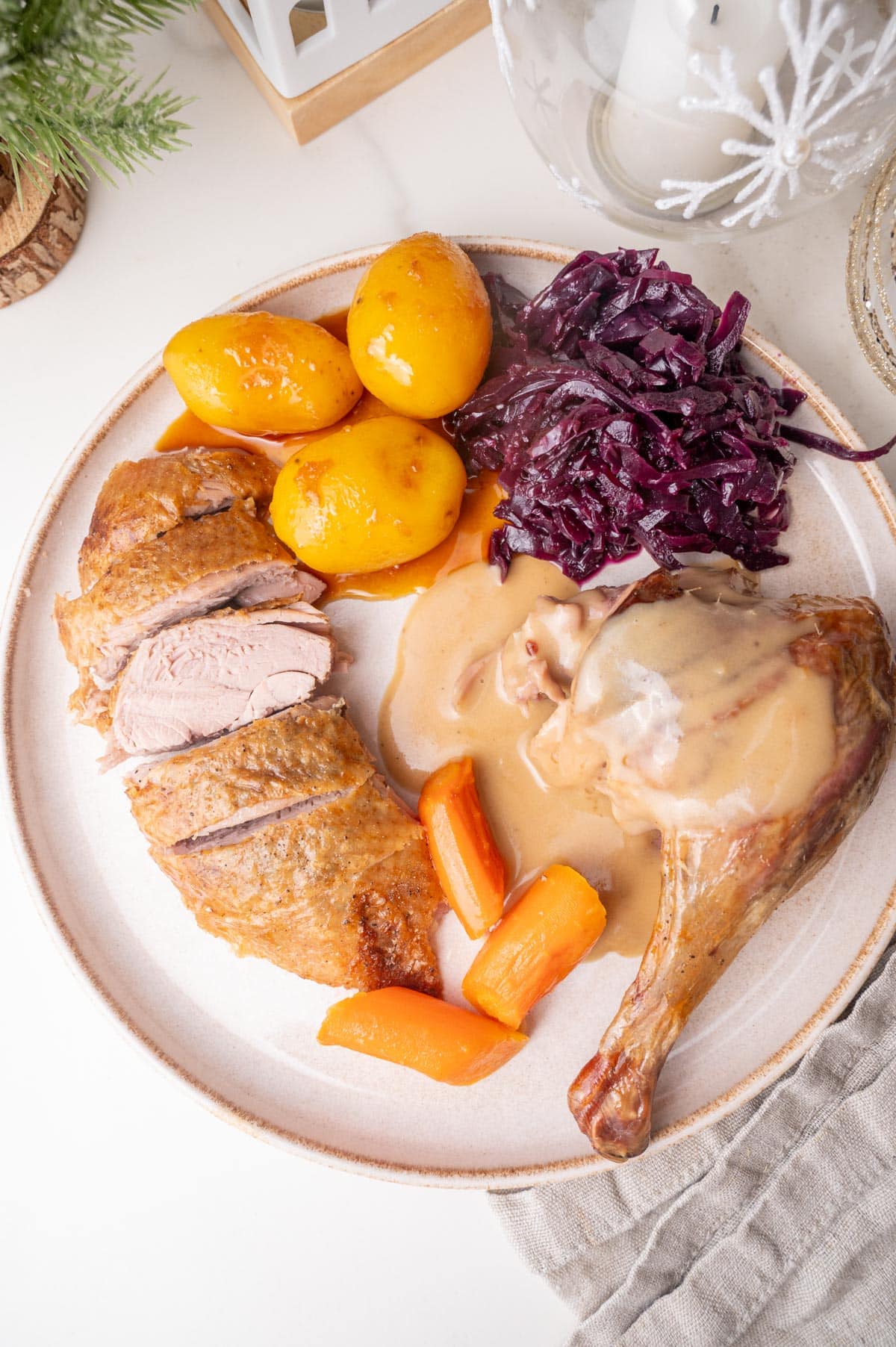
Danish Christmas Duck (Andesteg) is a classic holiday roast with crispy skin, juicy meat, and the most amazing pan drippings for gravy. The duck is traditionally stuffed with apple and prunes, which gently perfume the meat as it roasts. Serve it the Danish way with rich duck gravy, caramelized potatoes (brunede kartofler), and sweet-tart braised red cabbage for a true Christmas dinner.
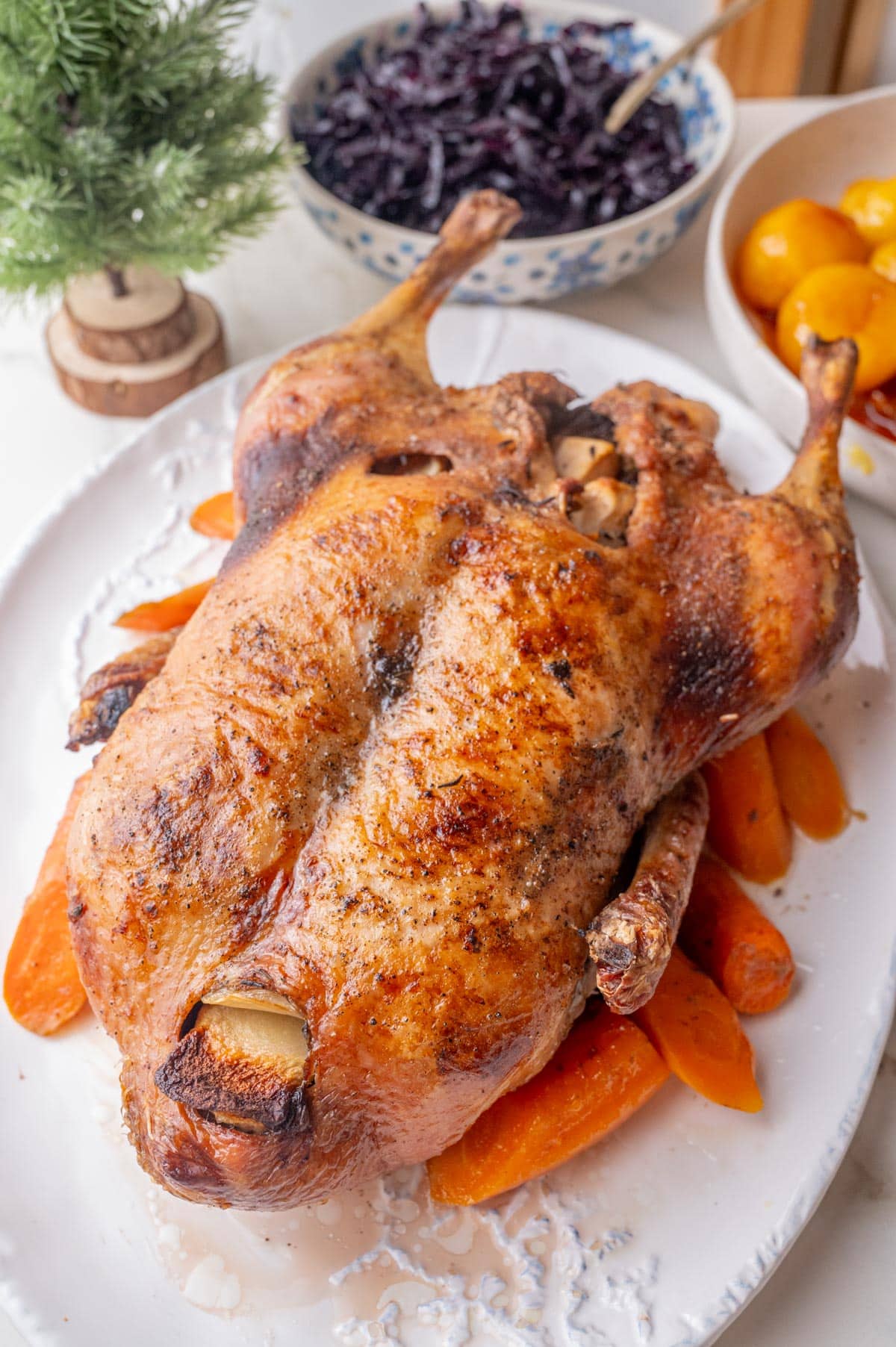
Ingredients
Here’s what you need for the duck and the stuffing:
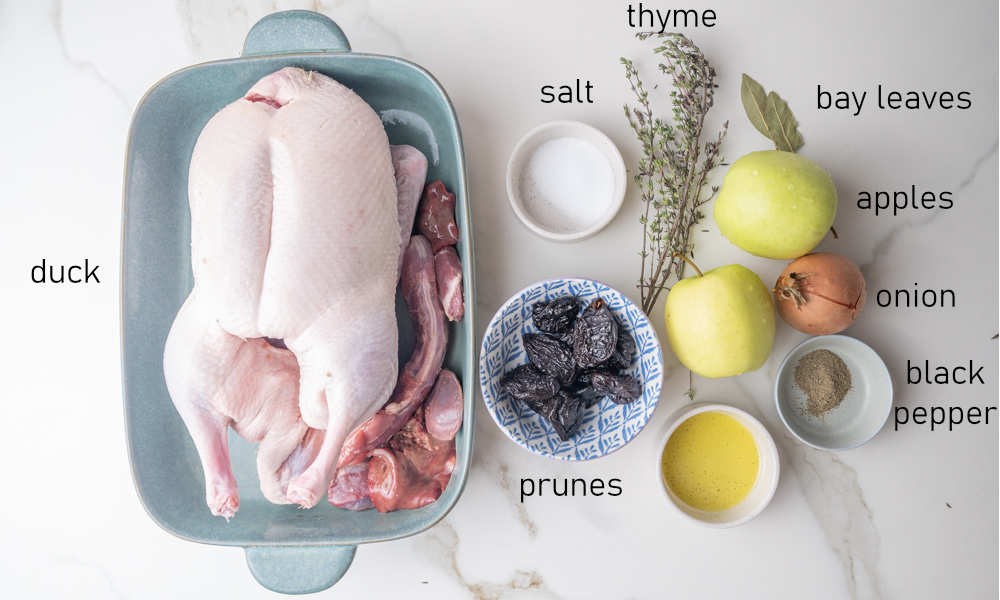
For the duck and stuffing, you’ll need a whole duck, plus apples, prunes, and onion — this classic Danish stuffing combo is what really differentiates Danish Christmas duck and gives it its signature sweet-savory flavor. Season the duck simply with plenty of salt and black pepper, then add a few bay leaves and fresh thyme for extra flavor.
Here’s what you need for the roasting pan:
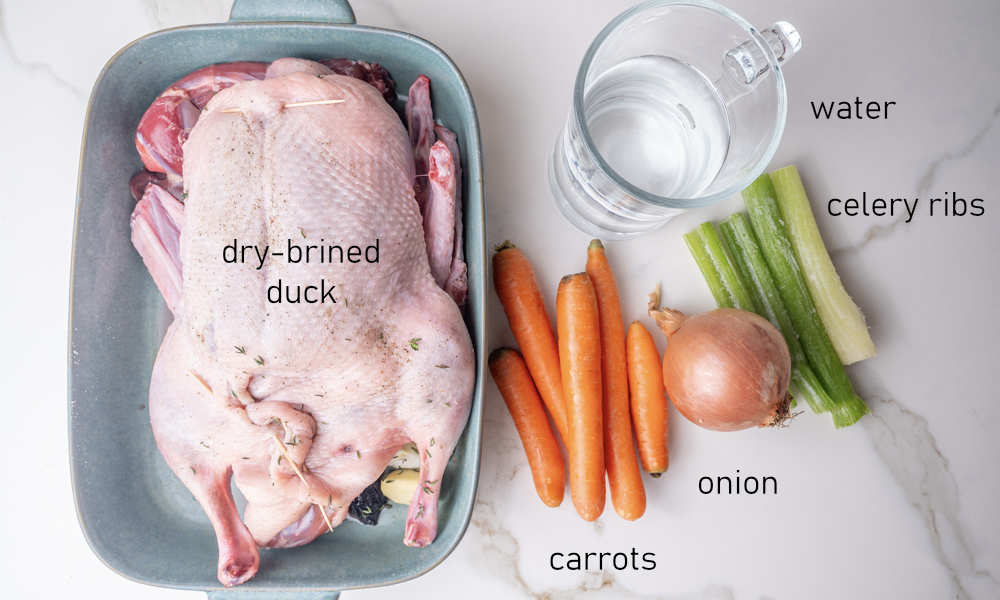
For the roasting pan, add a simple bed of vegetables (carrots, celery ribs, and onion) and a little water. These aromatics gently steam the duck as it roasts and help create flavorful drippings for the sauce.
Here’s what you need for a traditional Danish duck sauce (Christmas sauce):
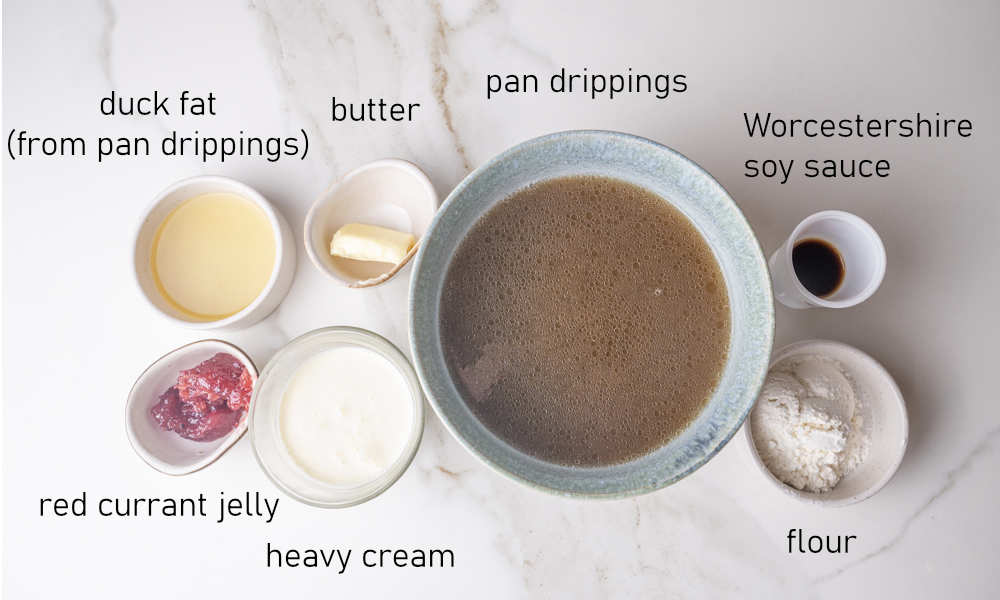
For the sauce, use the pan drippings (and a little rendered duck fat) as the base, then thicken with butter and flour. Finish it the traditional Danish Christmas way with heavy cream and a spoonful of red currant jelly, plus a splash of Worcestershire and soy sauce for extra depth and color.
The secret ingredient
The secret ingredient here is simple: salt– and using it for a dry brine. Brining the duck, just like you would a turkey, is a game-changer for getting juicy, tender, well-seasoned meat!
I prefer dry brining over wet brining: it’s easier to store a dry duck in the fridge than a big container of salty water, and the flavor is more concentrated, not watery. For a 4 3/4 lb (2.2kg) duck, I use about 3-4 teaspoons of table salt (or fine sea salt). Rub the duck all over with salt (and spices) – outside, inside the cavity, and especially under the skin of the breasts. Duck skin is thick and fatty, so lifting it gently and rubbing the salt directly onto the breast meat helps the seasoning really penetrate.
Since duck is both a special-occasion dish and an expensive bird, this simple extra step is absolutely worth it to get the best possible result.
How many people does one roasted duck serve?
Unfortunately, a duck does not have much meat – it yields less than chicken or turkey. One duck usually serves 2–3 people. That’s 2–3 elegant portions you would serve to your guests. We serve 1 leg plus ½ breast per person, but some people will eat 1 leg plus 1 whole breast. It also depends on how big the duck is.
Baking method
This duck is baked on a wire rack set over a baking dish filled with vegetables and giblets, which flavor the pan drippings for the gravy. Roasting the duck on a rack helps the skin get crisp. I don’t like scoring the skin over the breasts — it can make the skin a little crispier, but it also dries out the breast meat, which I love. When you leave the skin intact, the breast stays moist and juicy.
I also have another roasting method you might like: my Polish roast duck recipe (a reader favorite). For that method, you’ll need a large baking dish or a Dutch oven big enough to fit the duck. The duck bakes covered most of the time, so it almost braises in its own juices and turns out very soft and tender. Both methods are great and result in a succulent roast duck.
For me, the key to roasting duck is: brining for a full day (see the paragraph above) and roasting it a little longer than just “safe to eat” temperature. Duck won’t be dry — trust me, it will be even better. You can read the reader comments under my roast duck recipe.
How to make it step-by-step
Before you start: If you have bought a frozen duck: it should be thawed in the refrigerator for at least 24 hours, overnight won’t be enough. Even if a duck thawed overnight appears to be thawed from the outside, it’s usually still partially frozen on the inside, and it‘s hard to remove the neck and giblets that are most often put there. The duck must be completely thawed, or it won’t cook evenly.
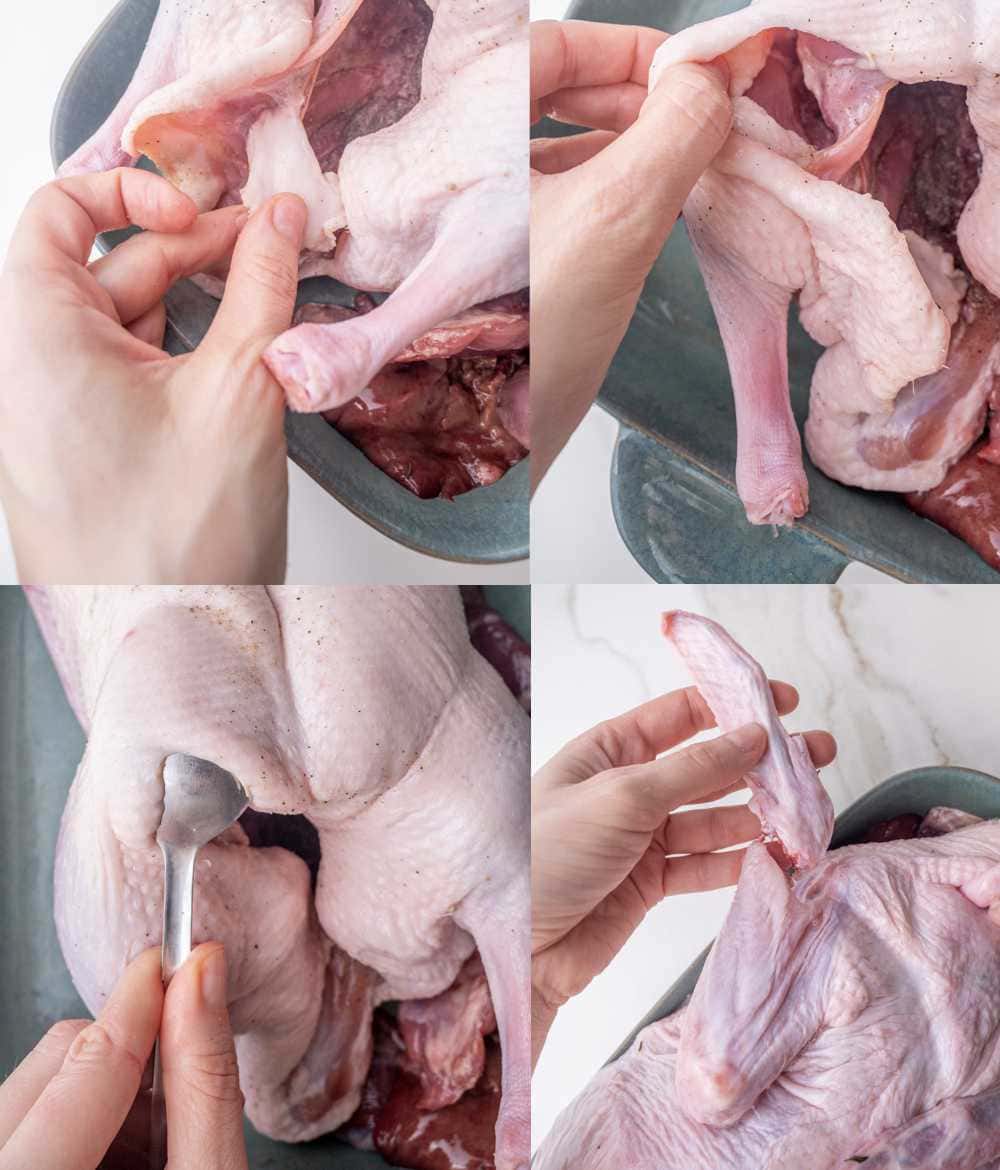
The day before: Prepare the duck – remove the giblets and neck from the cavity (you can reserve them for the gravy). Clean the duck with wet paper towels, then pat dry with dry paper towels (inside and outside). Trim excess fat around the tail and neck (you can reserve it and cook it in a small pot over low/medium heat until the fat is melted and use it to flavor other recipes, such as braised red cabbage and caramel potatoes). Cut off the tips of the wings (they usually just burn in the oven, you can also use them to flavor the drippings). These steps are shown on the photos in the body of the post, above the recipe card.
Prepare dry brine: Rub the duck with salt and pepper. You need to rub it inside, outside, then loosen the skin from the duck breasts and legs (without totally detaching it), and rub thoroughly with salt under the skin.
(4 3/4- to 5-pound whole duck (2.2 kg), 4 teaspoons table salt, ½ teaspoon ground black pepper)
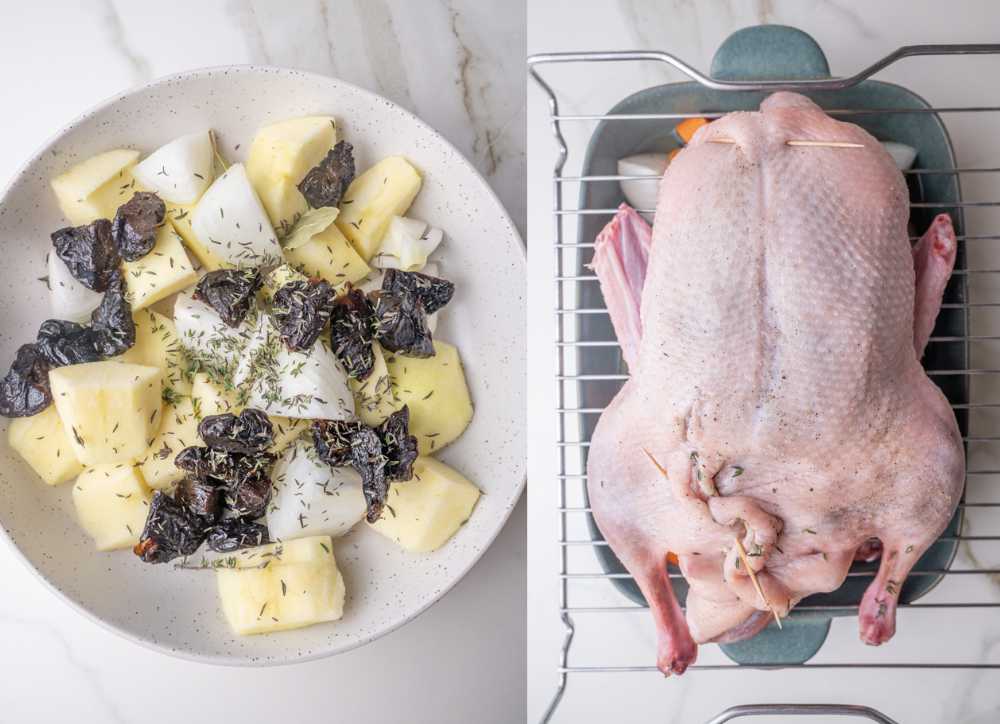
Prepare the stuffing: Peel and core the apples, cut into quarters, and then in half. Cut prunes in half. Peel the onion and cut it into quarters or smaller (simply large chunks). Combine these ingredients in a bowl with bay leaves and thyme leaves. Place inside the duck cavity, as much as it fits, then close both cavities with a toothpick (optional, but it helps the filling to not fall out). If you have some onions/apples/prunes left, simply place them in the roasting pan with the duck; you can bake the duck with them, and they will flavor the pan drippings.
(1-2 tart apples, I used Golden Delicious, 1 large or 2 small, 1 medium/large onion, 2 bay leaves, 12 prunes, a couple of sprigs of thyme)
Dry brine for 1 day: Place the duck in a large dish in the fridge, uncovered, at least overnight, but better for one whole day.
On the day of baking: Take the duck out of the fridge, leave it on the counter for 60 minutes to warm up.
Preheat the oven to 325°F (160°C).
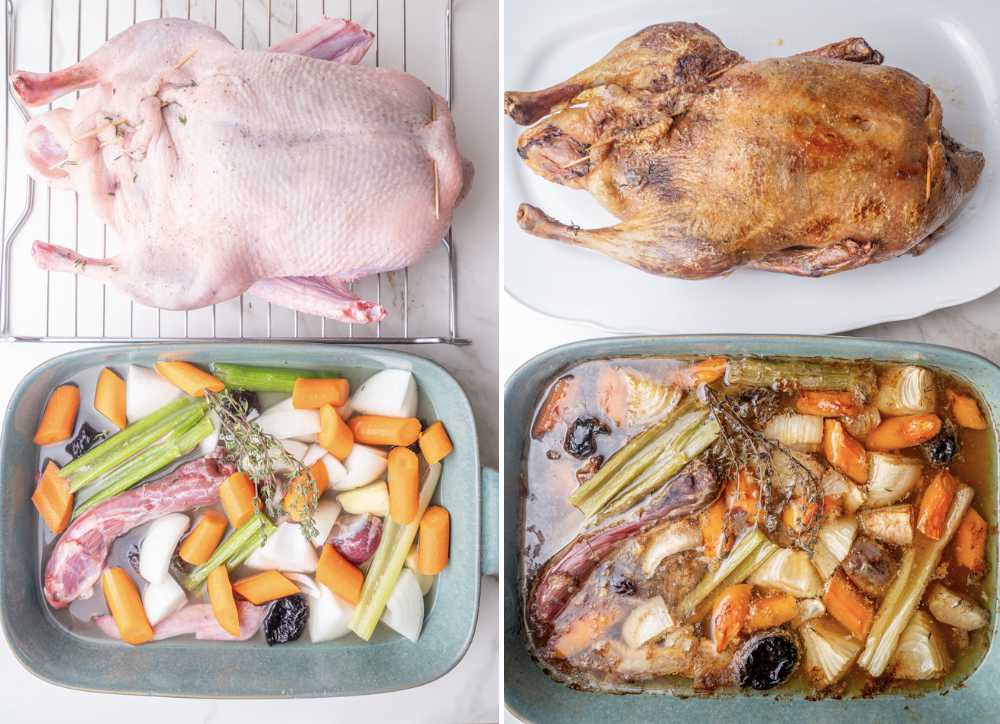
Prepare the roasting tray: Peel the carrots and cut them at an angle into large chunks (if you have very large carrots, cut them also in half lengthwise). Add to a large roasting pan. Add the giblets, neck, and wing tips, if using. Cut the onion and celery ribs into large chunks and add to the pan. You can also add any other flavorings you like. Add 1 1/2 cups of water. Place the rack over the baking dish, then place the duck on top. Pat dry the skin of the duck with paper towels, then sprinkle again with some salt.
(4 carrots, 1 onion, 2 celery ribs, Giblets and neck of the duck, if available, 1 1/2 cups (360ml) water, A couple of sprigs of thyme)
Bake the duck: Bake the duck for 3 hours (if your duck is smaller or bigger, shorten or increase the baking time accordingly, but don’t worry, a couple of minutes shorter or longer won’t make a big difference). If your duck is not very browned, you can turn up the heat to 425°F (220°C) at the end of the baking time (for the last 15 minutes) or put the duck under the broiler for a couple of minutes to brown the skin (watch out if it’s not burning). I simply like to use my crème brulee flame to brown the skin a little bit more outside the oven.
Take the duck out of the oven and let it rest for at least 15-20 minutes. In that time, you can make the gravy.
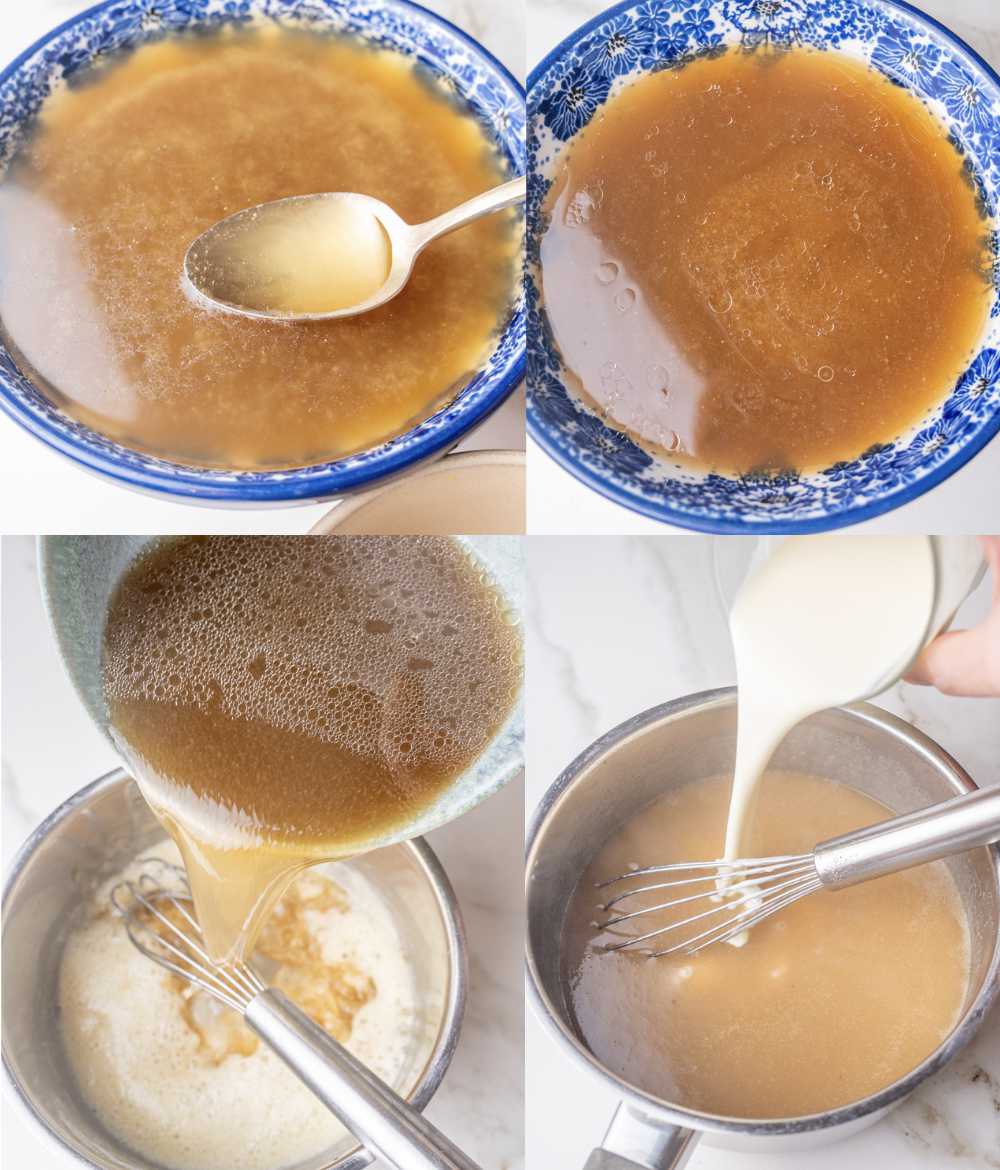
Make the gravy: Strain the vegetables, leaving the baking liquid in a medium saucepan. Most of this liquid is fat. Put the drippings in the fridge for 10 minutes, and the fat will collect on top (it’s more clear and yellow than the roasting liquid). Scoop the fat with a spoon or a ladle; you will need 2 tablespoons for the gravy. You can discard the rest or use it in other recipes. You should have about 2 cups of liquid left; if you have less, fill the difference with water.
In a medium saucepan, melt the butter and reserved duck fat. When bubbling, add the flour, and cook, whisking often, for 1-2 minutes. Add the pan drippings, and cook for a couple of minutes. Add the remaining ingredients and cook for a couple of minutes or until thickened. Season with salt, pepper, and lemon juice, if needed.
(2 tablespoons duck fat, 2 tablespoons butter, ¼ cup (30g) flour, 2 cups of pan drippings, 1/3 cup (80ml) heavy cream, 2 tablespoons red currant jelly, 1 teaspoon Worcestershire sauce, 1 teaspoon soy sauce, A couple of drops of lemon juice, Salt and pepper, to taste)
Roasted carrots – they will be covered in small bits from the duck drippings, so I like to wash them on a sieve, then cook briefly with a small amount of butter, orange juice (I am using orange zest for the braised red cabbage), and honey, until warm and glazed, similar to this recipe for stovetop glazed carrots. This is, of course, optional.
Carve the duck into pieces and serve with the gravy, roasted carrots, apples, and prunes.
Enjoy!
What to do with leftover roast duck bones
Super important: DO NOT throw away the leftover carcass and bones! You can make a stock from them! It comes out really delicious and aromatic; it can be a base for many soups or sauces (like this duck ragu), and it can also be frozen. I usually use it to make French onion soup. It tastes amazing, better than with beef stock.
I think this is especially important because there isn’t much meat on a duck, so this is another way to get more value for your money.
If you don’t want to make stock right away, you can freeze the bones and carcass and cook the stock when you have time. You can add the frozen bones and carcass straight to the pot, without thawing.
How to make roasted duck bone broth:
It couldn’t be simpler. Add the roasted duck carcass, all leftover bones, and skin to a large pot. Add the vegetables (2 carrots, 1 parsley root (optional), 1/2 of a leek, a piece of celeriac or 2 stalks of celery, and an onion) and the spices: a few black peppercorns, 3 bay leaves, 3 allspice berries, 1 unpeeled garlic clove, 2 small dried mushrooms (optional), and a few sprigs of parsley or thyme. Peel the vegetables and cut the larger ones into 2–3 pieces. Cover everything with water — about 8 cups (2 liters). You can also add the duck neck and giblets, if not used for roasting. Simmer for about 1 1/2 hours (or longer for a more concentrated broth), then strain. Use right away or freeze.
You can also make the broth Asian-style: add a piece of fresh ginger, star anise, chopped lemongrass, and season with a little soy sauce.
Did you make this recipe? RATE THE RECIPE or tell me in the COMMENTS how you liked it! You can also add a photo of your dish. It would make me very happy and will help other readers. Thank you!!
Danish Christmas Duck (Andesteg)

składniki
For the duck:
- 4 3/4- to 5- pound (2.2 kg) whole duck
- 4 teaspoons table salt
- ½ teaspoon ground black pepper
- 1-2 tart apples I used Golden Delicious, 1 large or 2 small
- 1 medium/large onion
- 2 bay leaves
- 12 prunes
- a couple of sprigs thyme
Roasting pan:
- 4 carrots
- 1 onion
- 2 celery ribs
- Giblets and neck of the duck if available
- 1 1/2 cups (360ml) water
- A couple of sprigs thyme
For the gravy:
- 2 tablespoons duck fat you will have it from the pan drippings, no need to buy
- 2 tablespoons butter
- ¼ cup (30g) flour
- 2 cups of pan drippings
- 1/3 cup (80ml) heavy cream
- 2 tablespoons red currant jelly
- 1 teaspoon Worcestershire sauce
- 1 teaspoon soy sauce
- A couple of drops lemon juice
- Salt and pepper to taste
Would you like to save this?
wykonanie
- The day before: Prepare the duck – remove the giblets and neck from the cavity (you can reserve them for the gravy). Clean the duck with wet paper towels, then pat dry with dry paper towels (inside and outside). Trim excess fat around the tail and neck (you can reserve it and cook it in a small pot over low/medium heat until the fat is melted and use it to flavor other recipes, such as braised red cabbage and caramel potatoes). Cut off the tips of the wings (they usually just burn in the oven; you can also use them to flavor the drippings). These steps are shown in the photos in the body of the post, above the recipe card.4 3/4- to 5- pound (2.2 kg) whole duck
- Prepare dry brine: Rub the duck with salt and pepper. You need to rub it inside, outside, then loosen the skin from the duck breasts and legs (without totally detaching it) and rub thoroughly with salt under the skin.4 teaspoons table salt, ½ teaspoon ground black pepper
- Prepare the stuffing: Peel and core the apples, cut them into quarters, and then in half. Cut prunes in half. Peel the onion and cut into quarters or smaller (simply large chunks). Combine these ingredients in a bowl with bay leaves and thyme leaves. Place inside the duck cavity, as much as it fits, then close both cavities with a toothpick (optional, but it helps the filling to not fall out). If you have some onions/apples/prunes left, simply place them in the roasting pan with the duck; you can bake the duck with them, and they will flavor the pan drippings.1-2 tart apples, 1 medium/large onion, 2 bay leaves, 12 prunes, a couple of sprigs thyme
- Dry-brine for 1 day: Place the duck in a large dish in the fridge, uncovered, at least overnight, but better for one whole day.
- On the day of baking: Take the duck out of the fridge, leave it on the counter for 60 minutes to warm up.
- Preheat the oven to 325°F (160°C).
- Prepare the roasting tray: Peel the carrots and cut them at an angle into large chunks (if you have very large carrots, cut them also in half lengthwise). Add to a large roasting pan. Add the giblets, neck, and wing tips, if using. Cut the onion and celery ribs into large chunks and add to the pan. You can also add any other flavorings you like. Add 1 1/2 cups of water. Place the rack over the baking dish, then place the duck on top. Pat dry the skin of the duck with paper towels, then sprinkle again with some salt.4 carrots, 1 onion, 2 celery ribs, Giblets and neck of the duck if available, 1 1/2 cups (360ml) water, A couple of sprigs thyme
- Bake the duck: Bake the duck for 3 hours (if your duck is smaller or bigger, shorten or increase the baking time accordingly, but don’t worry, a couple of minutes shorter or longer won’t make a big difference). If your duck is not very browned, you can turn up the heat to 425°F (220°C) at the end of the baking time (for the last 15 minutes) or put the duck under the broiler for a couple of minutes to brown the skin (watch out if it’s not burning). I simply like to use my crème brulee flame to brown the skin a little bit more outside the oven.
- Take the duck out of the oven and let it rest for at least 15-20 minutes. In that time you can make the gravy.
- Make the gravy: Strain the vegetables, leaving the baking liquid in a medium saucepan. Most of this liquid is fat. Put the drippings in the fridge for 10 minutes and the fat will collect on top (it’s more clear and yellow than the roasting liquid). Scoop the fat with a spoon or a ladle; you will need 2 tablespoons for the gravy. You can discard the rest or use it in other recipes. You should have about 2 cups of liquid left; if you have less, fill the difference with water.
- In a medium saucepan, melt the butter and reserved duck fat. When bubbling, add the flour, and cook, whisking often, for 1-2 minutes. Add the pan drippings, and cook for a couple of minutes. Add the remaining ingredients and cook for a couple of minutes or until thickened. Season with salt, pepper, and lemon juice, if needed.2 tablespoons duck fat, 2 tablespoons butter, ¼ cup (30g) flour, 2 cups of pan drippings, 1/3 cup (80ml) heavy cream, 2 tablespoons red currant jelly, 1 teaspoon Worcestershire sauce, 1 teaspoon soy sauce, A couple of drops lemon juice, Salt and pepper
- Roasted carrots – they will be covered in small bits from the duck drippings, so I like to wash them on a sieve, then cook briefly with a small amount of butter, orange juice (I am using orange zest for the braised red cabbage), and honey, until warm and glazed, similar to this recipe for stovetop glazed carrots. This is, of course, optional.
- Carve the duck into pieces and serve with the gravy, roasted carrots, apples, and prunes.
- Enjoy!
uwagi
- If you have bought a frozen duck: it should be thawed in the refrigerator for at least 24 hours, overnight won’t be enough. Even if a duck thawed overnight appears to be thawed from the outside, it’s usually still partially frozen on the inside, and it‘s hard to remove the neck and giblets that are most often put there. The duck must be completely thawed, or it won’t cook evenly.
- Calories = 1 serving (1/4 of the recipe). This is only an estimate!


Brak komentarzy